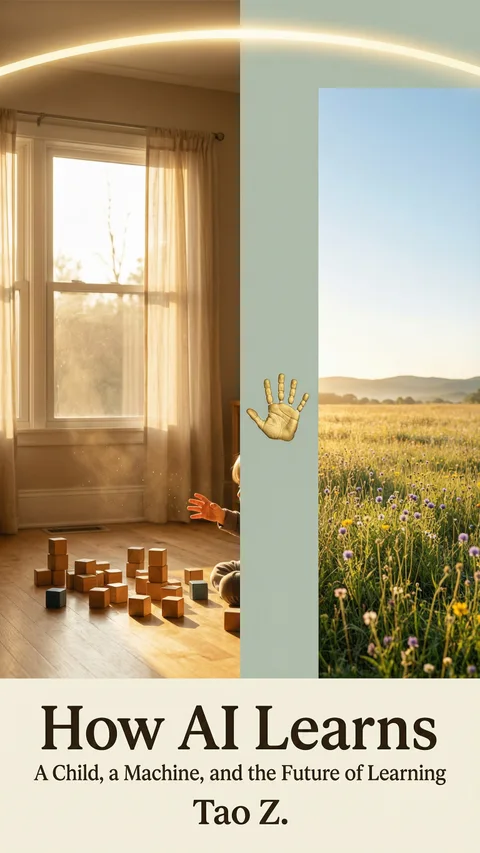
How AI Learns
A Child, a Machine, and the Future of Learning
By Tao Zhen
How AI Learns is a conceptual book for parents, teachers and general readers. It contrasts a child’s experience with model training through narrative examples. The comparison is illustrative, not a claim of equivalent mechanisms or a measured learning-efficiency ratio. Read the sample to judge whether the narrative approach suits you.
How is machine learning different from a child’s learning?
The book compares a child learning through relationships and physical experience with a model learning through data and optimization. The comparison is a teaching device, not a claim that the two mechanisms are equivalent. It is intended to help readers ask better questions about educational AI, rather than prescribe classroom interventions.
Who this book is for
- Parents and teachers seeking a conceptual comparison of human and machine learning.
- General readers comfortable with narrative examples rather than training code.
Publisher-owned book. Sales support its author. Disclosure.
View edition and price on Amazon →
Check the current edition, price and availability on Amazon.
Book details
- Author
- Tao Zhen
- Format
- Kindle ebook
- Length
- 190 pages
- ASIN
- B0H5FSYT1G
Sample from the manuscript
Source section: Why This Comparison Matters Now.
We may be living through one of the most significant transformations in learning in centuries.
Let me be specific about what’s happening right now, as you read this book.
By the mid-2020s, surveys suggested that student use of ChatGPT for schoolwork had become widespread. Not secretly. Not ashamed. Openly, casually, as naturally as using a calculator or searching Google. These students aren’t cheating—they’re adapting. They’ve grown up in a world where AI is becoming just another everyday tool—more like search or software than science fiction.
Meanwhile, AI tutors are being deployed in schools across Asia, Europe, and North America. In several countries, including China, AI-powered learning apps had already become part of everyday study routines for large numbers of students. In the United States, districts are piloting AI teaching assistants. In India, AI tutors are reaching students in villages that have never had access to quality education.
This is not science fiction. This is not coming soon. This is happening now.
And it raises questions we can no longer avoid.
If AI can answer questions, write essays, solve problems, translate languages—what should we teach? These aren’t hypothetical questions. They’re urgent questions that parents, teachers, and policymakers face today.
The answer lies in understanding how humans learn versus how AI learns. When you understand how a child learns language through social interaction, you see why AI misses emotional subtext. When you understand how a child learns morality through lived experience, you see why today’s AI systems can follow ethical guidelines without possessing the emotional foundations that make moral reasoning meaningful. When you understand how curiosity drives exploration, you see why today’s systems can generate questions on request, but they do not appear to exhibit intrinsic curiosity in the human sense.
Chapter outline
This outline includes the manuscript’s chapter and part headings; subsection titles and references are omitted.
- Introduction: Two Paths of Growth
- Part I: The Beginning
- Chapter 1: The First Cry
- Chapter 2: The Brain’s First Year
- Chapter 3: Mother’s Voice
- Chapter 4: Ocean of Data
- Chapter 5: “Why?”
- Part III: Rules and Refinement
- Chapter 6: The Cost of Hallucination
- Chapter 7: The Awakening of Rules
- Chapter 8: The Art of Fine-tuning
- Chapter 9: The Birth of Spatial Sense
- Part IV: Experience and Perception
- Chapter 10: When AI Sees the World
- Chapter 11: Growing Up Together
What the book aims to help you do
- Explain in plain terms what changes inside a model during training.
- Describe the specific ways child learning differs from gradient descent, without mystifying either.
- Judge claims about "AI that learns like a child" against what the mechanisms actually do.
Who this is not for
- Practitioners who want training recipes or hyperparameters — this is conceptual, not operational.
- Readers who already know the mechanics of backpropagation and want new technical depth.
Known limitations
- The child-development comparison is illustrative; the book does not claim the two mechanisms are formally equivalent.
- Coverage of adversarial training and RLHF is brief relative to their practical importance.
Questions before buying
How is machine learning different from a child’s learning?
The book compares a child learning through relationships and physical experience with a model learning through data and optimization. The comparison is a teaching device, not a claim that the two mechanisms are equivalent. It is intended to help readers ask better questions about educational AI, rather than prescribe classroom interventions.
Who is this book for?
Parents and teachers seeking a conceptual comparison of human and machine learning. General readers comfortable with narrative examples rather than training code.
Can I read a sample before buying?
A sample and chapter outline are included on this page. Check the retailer for the current edition, price and availability.
Related reading
Sample from “Why This Comparison Matters Now”. Updated 2026-10-24. Prepared with AI assistance.