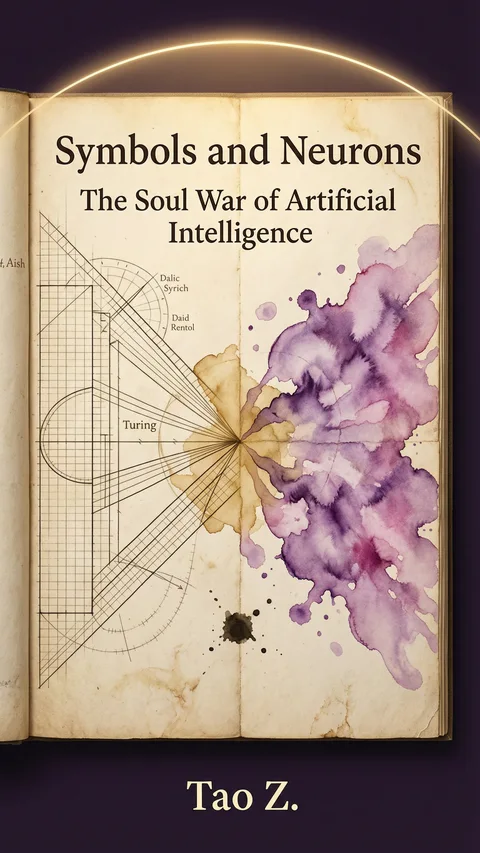
Symbols and Neurons
The Soul War of Artificial Intelligence
By Tao Zhen
Symbols and Neurons introduces the history of symbolic and connectionist AI through a narrative account. It is intended for readers seeking context for debates about representations, learning and reasoning. Historical scenes and reconstructed dialogue should be distinguished from primary research. The book is not an exhaustive survey or implementation manual.
Why do symbolic and neural approaches to AI keep returning?
Symbolic systems emphasize explicit representations and rules; neural systems learn representations from examples. This book tells the history of their competing ambitions and recurring limitations through a narrative lens. It provides historical context, rather than a complete research survey or an implementation guide to contemporary hybrid systems.
Who this book is for
- Readers interested in the intellectual history of symbolic and neural AI.
- General readers seeking context for debates about hybrid systems.
Publisher-owned book. Sales support its author. Disclosure.
View edition and price on Amazon →
Check the current edition, price and availability on Amazon.
Book details
- Author
- Tao Zhen
- Format
- Kindle ebook
- Length
- 134 pages
- ASIN
- B0H67ZQGZR
Sample from the manuscript
Source section: Introduction: The Hundred-Year Soul War.
The Dinner That Changed Everything
It was a Thursday evening in October 2019, and I was sitting in a cramped faculty lounge at a university I won’t name, watching two of the smartest people I’d ever met try to destroy each other’s life work over cheap wine.
Professor Elias—let’s call him that—was seventy-one, with ink-stained fingers and a habit of drawing logical proofs on napkins. He had spent forty years building knowledge representations: elegant systems of rules and symbols that could, in principle, capture everything a doctor knows about diagnosing pneumonia or a lawyer knows about contract law. His office smelled of old books and chalk dust. He believed, with the quiet conviction of a man who had thought about this longer than most of his students had been alive, that intelligence was reasoning—the manipulation of symbols according to rules.
Professor Nadia—again, not her real name—was fifty-three, with a neural network training on her laptop even as she argued. She had come to AI from neuroscience, specifically from studying how the visual cortex learned to recognize faces. She believed, with equal conviction, that intelligence was pattern recognition—the slow, statistical accumulation of regularities from experience. Her lab ran on GPUs. Her coffee cup said “Backprop or Die.”
They had been friends for fifteen years. That evening, something snapped.
“You’re building cathedrals in the sand,” Elias said, his voice low but sharp. “Your networks learn correlations, not concepts. They don’t understand anything.”
Chapter outline
This outline includes the manuscript’s chapter and part headings; subsection titles and references are omitted.
- Introduction: The Hundred-Year Soul War
- Chapter 1: Turing’s Question — Can Machines Think?
- Chapter 2: The Golden Age of Symbolism — When Logic Ruled AI
- Chapter 3: Minsky’s Curse — Why the Perceptron Was Killed
- Chapter 4: Connectionism’s Revival — Backpropagation Changes the World
- Chapter 5: The Deep Learning Explosion — When Data Met Compute
- Chapter 6: The Emergence of LLMs — Is Scale the Answer?
- Chapter 7: The Symbolist Counterattack — Why Neural Networks Aren’t Enough
- Chapter 8: The Brain’s Answer — How Neurons and Symbols Coexist
- Chapter 9: Neurosymbolic AI — The Next Decade’s Battleground
- Chapter 10: Knowledge Graphs and LLMs — The Handshake
- Chapter 11: Embodied AI — When Robots Learn to Feel the World
- Chapter 12: Is AGI Possible — The Ultimate Question
- Chapter 13: Humanity’s Position — In the Ecosystem of Intelligence
What the book aims to help you do
- Place current models inside a seventy-year argument instead of treating them as a rupture.
- Explain what the symbolic side was right about, and why it lost the argument for a generation.
- Read today’s neurosymbolic claims with the history that makes them legible.
Who this is not for
- Readers who want practical guidance on using AI tools; this is intellectual history.
- Anyone allergic to named philosophers and dated disputes.
Known limitations
- Selective by necessity — several schools get a paragraph where they deserve a chapter.
- Ends before the most recent wave of hybrid systems, which are mentioned but not assessed.
Questions before buying
Why do symbolic and neural approaches to AI keep returning?
Symbolic systems emphasize explicit representations and rules; neural systems learn representations from examples. This book tells the history of their competing ambitions and recurring limitations through a narrative lens. It provides historical context, rather than a complete research survey or an implementation guide to contemporary hybrid systems.
Who is this book for?
Readers interested in the intellectual history of symbolic and neural AI. General readers seeking context for debates about hybrid systems.
Can I read a sample before buying?
A sample and chapter outline are included on this page. Check the retailer for the current edition, price and availability.
Related reading
Sample from “Introduction: The Hundred-Year Soul War”. Updated 2026-10-24. Prepared with AI assistance.