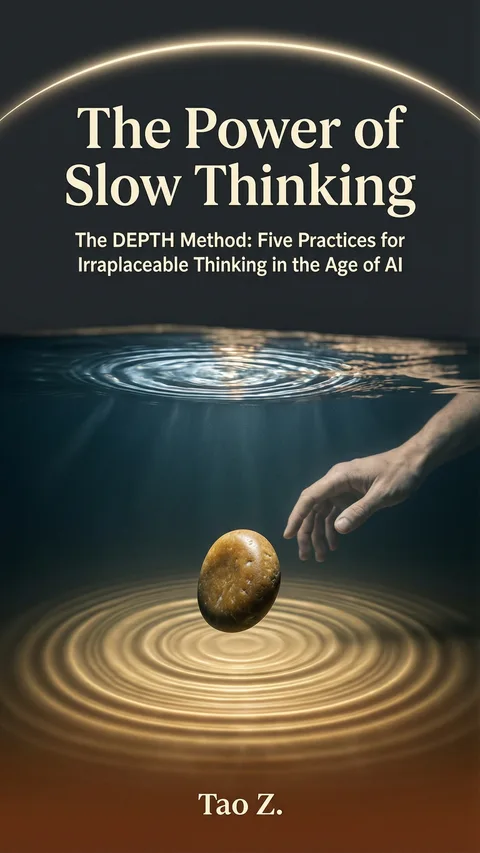
The Power of Slow Thinking
The DEPTH Method: Five Practices for Irreplaceable Thinking in the Age of AI
By Tao Zhen
The Power of Slow Thinking proposes the DEPTH framework for reflecting on thought and delegation in AI-assisted work. It combines a conceptual argument with practical exercises. The method is an author’s proposal, not an experimentally validated intervention or a promise of productivity gains; readers should assess its fit through the sample.
How can you use AI while keeping responsibility for your thinking?
The book proposes DEPTH as a practical framework for slowing down selected decisions and reflecting on AI assistance. Its exercises are prompts for personal practice, not a clinically validated intervention or a measured guarantee of productivity. Read the sample and the limitations before deciding whether this approach suits your work.
Who this book is for
- Knowledge workers designing a more deliberate relationship with AI tools.
- Readers willing to try reflection exercises rather than collect prompts.
Publisher-owned book. Sales support its author. Disclosure.
View edition and price on Amazon →
Check the current edition, price and availability on Amazon.
Book details
- Author
- Tao Zhen
- Format
- Kindle ebook
- Length
- 202 pages
- ASIN
- B0GZCKNMZM
Sample from the manuscript
Source section: The Collaboration Principle.
None of this means AI isn’t useful. AI is extraordinarily useful—particularly as a catalyst for human depth.
AI can:
- Process data faster than you, freeing your attention for judgment
- Generate options you wouldn’t have considered, expanding your decision space
- Handle routine cognitive work, preserving your energy for depth
- Provide information on demand, supporting your learning
But AI cannot replace your depth. It can support it, augment it, free time for it—but the depth itself must come from you.
The DEPTH collaboration principle: Use AI for speed. Reserve DEPTH for significance.
Let me show you what this looks like in practice, with a real-world example from a team I worked with last year.
A product team at a mid-size tech company was struggling to develop a new feature. They had user research, competitive analysis, and technical constraints. The challenge was synthesizing all of this into a coherent product direction. They tried three approaches:
Approach 1: AI-only. They fed all the data into an AI and asked it to recommend a direction. The AI produced a comprehensive analysis with clear recommendations. The team followed the recommendations. The feature launched. It performed adequately—but not exceptionally. Users didn’t love it. They just used it.
Approach 2: Human-only. The team spent two weeks in meetings, debating, analyzing, trying to reach consensus. The process was exhausting. The decision was compromised—every voice had been heard, but no one was satisfied. The feature launched. It was confusing. Users didn’t understand it.
Chapter outline
This outline includes the manuscript’s chapter and part headings; subsection titles and references are omitted.
- Introduction: The Irreplaceable Human
- Chapter 1: D — Deliberate Pause
- Chapter 2: E — Embodied Reflection
- Chapter 3: P — Prolonged Attention
- Chapter 4: T — Transformative Learning
- Chapter 5: H — Human Judgment
- Chapter 6: The DEPTH Integration — A Day in the Life
- Chapter 7: DEPTH and Creativity — The Art of Original Thought
- Chapter 8: DEPTH and Communication — Depth Made Visible
- Chapter 9: The Irreplaceable Human — Why AI Cannot DEPTH
- Chapter 10: Your DEPTH Journey
- Conclusion: The Depth Revolution
What the book aims to help you do
- Run the five DEPTH practices on a piece of real work and see where the model adds and where it subtracts.
- Recognise the moment you have outsourced a judgement you needed to make yourself.
- Design a personal workflow that keeps human review at the points where it changes the outcome.
Who this is not for
- Readers looking for prompt collections or tool configurations.
- Anyone who wants the argument without the exercises — the practices only work if you do them.
Known limitations
- The practices are described but not validated by a study; the evidence offered is anecdotal.
- Assumes you already use AI tools daily; it is not an introduction to them.
Questions before buying
How can you use AI while keeping responsibility for your thinking?
The book proposes DEPTH as a practical framework for slowing down selected decisions and reflecting on AI assistance. Its exercises are prompts for personal practice, not a clinically validated intervention or a measured guarantee of productivity. Read the sample and the limitations before deciding whether this approach suits your work.
Who is this book for?
Knowledge workers designing a more deliberate relationship with AI tools. Readers willing to try reflection exercises rather than collect prompts.
Can I read a sample before buying?
A sample and chapter outline are included on this page. Check the retailer for the current edition, price and availability.
Related reading
Sample from “The Collaboration Principle”. Updated 2026-10-24. Prepared with AI assistance.