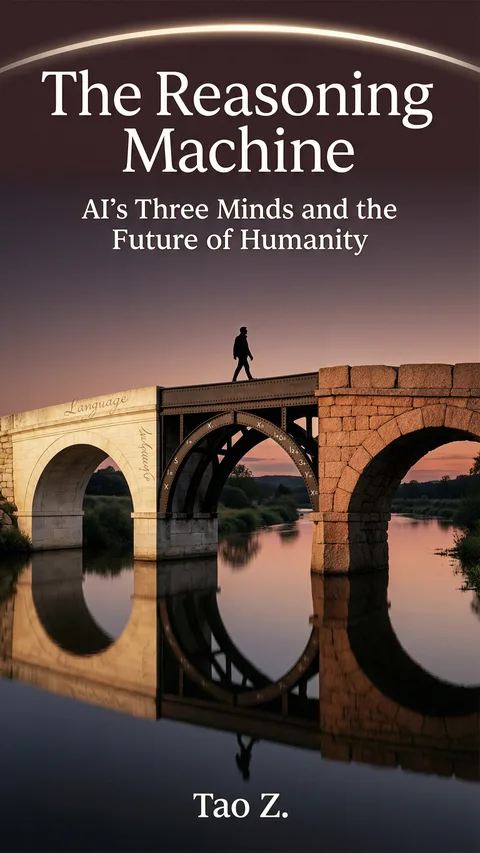
The Reasoning Machine
AI's Three Minds and the Future of Humanity
By Tao Zhen
The Reasoning Machine proposes linguistic, mathematical and spatiotemporal reasoning as three lenses on intelligence. It develops the framework through conceptual discussion and narrative scenes. The book is intended for readers who want to examine reasoning, not for buyers seeking an independently validated benchmark or a ranking of today’s models.
Does fluent AI output demonstrate reliable reasoning?
Language fluency is one part of a larger task. The book proposes linguistic, mathematical and spatiotemporal reasoning as three lenses for examining intelligence. Treat that framework as the author’s interpretation: it can structure questions about a task, but it does not replace task-specific testing or establish a current model ranking.
Who this book is for
- Developers and technical evaluators seeking a conceptual lens on reasoning.
- Readers interested in the relationship between language, formal reasoning and physical experience.
Publisher-owned book. Sales support its author. Disclosure.
View edition and price on Amazon →
Check the current edition, price and availability on Amazon.
Book details
- Author
- Tao Zhen
- Format
- Kindle ebook
- Length
- 107 pages
- ASIN
- B0H6836V4J
Sample from the manuscript
Source section: Introduction: The Three Minds Question.
Dr. Yuki Tanaka’s coffee had gone cold. She hadn’t noticed. On her laptop screen, a newly released AI system had just produced—in eleven seconds—a paragraph-by-paragraph analysis of a Supreme Court decision she had spent three weeks writing about for a law review article. Her cursor blinked at the end of her own draft, which suddenly looked labored, overwrought, slow. The AI’s analysis was not identical to hers. In places, it was better. Her hands were shaking slightly. She wasn’t sure why.
Yuki pushed back from her desk and walked to the window. Six floors below, a construction crew was erecting a new wing of the engineering building. She watched a worker navigate a steel beam across a narrow scaffold in a gusting wind—adjusting his grip, shifting his weight, timing his steps between gusts with a precision that came from somewhere deeper than thought. As of 2025, current AI systems still struggle with the kind of real-time physical integration that worker was performing. His body knew things that no language model would ever learn from text alone. And yet a machine had just done something that had taken Yuki, a trained legal scholar with two decades of constitutional expertise, three weeks of concentrated effort.
The disconnect was dizzying. A machine could reason about constitutional law but could not carry a beam across a scaffold. It could parse a seventy-page judicial opinion but could not predict that a cup placed near the edge of a table might fall. It could write about love without feeling it, describe pain without experiencing it, and explain justice without possessing any stake in the outcome.
Chapter outline
This outline includes the manuscript’s chapter and part headings; subsection titles and references are omitted.
- Introduction: The Three Minds Question
- Chapter 1: Three Minds in Collision
- Chapter 2: Linguistic Reasoning — The Home Field of LLMs
- Chapter 3: The Illusion of Language — When LLMs Say “I Understand”
- Chapter 4: Mathematical Reasoning — The Kingdom of Symbols
- Chapter 5: Spatiotemporal Reasoning — AI’s Blind Spot
- Chapter 6: The Body Is the Best Reasoning Machine
- Chapter 7: The Symphony of Three Minds — The True Secret of Human Intelligence
- Chapter 8: What Kind of Reasoning Is Programming?
- Chapter 9: The Evolutionary History of Reasoning — From Fish to Humans to AI
- Chapter 10: Which Reasoning Is Humanity’s Moat?
- Chapter 11: The Future of the Reasoning Machine — Human-AI Co-Reasoning
- Epilogue: A Letter to the Reader
What the book aims to help you do
- Classify a model failure by which kind of reasoning broke, not just "the AI was wrong".
- Predict in advance which tasks a model will handle badly before you hand it the work.
- Set review points where human judgement is structurally necessary rather than ceremonial.
Who this is not for
- Readers who want benchmark tables — there are no tables here, only a framework for reading them.
- Anyone expecting coverage of a specific vendor’s model lineup; the book stays above product level.
Known limitations
- Short by design (around 100 pages); several arguments are sketched rather than defended in full.
- The three-way split is a framing device, not a claim about model architecture.
Questions before buying
Does fluent AI output demonstrate reliable reasoning?
Language fluency is one part of a larger task. The book proposes linguistic, mathematical and spatiotemporal reasoning as three lenses for examining intelligence. Treat that framework as the author’s interpretation: it can structure questions about a task, but it does not replace task-specific testing or establish a current model ranking.
Who is this book for?
Developers and technical evaluators seeking a conceptual lens on reasoning. Readers interested in the relationship between language, formal reasoning and physical experience.
Can I read a sample before buying?
A sample and chapter outline are included on this page. Check the retailer for the current edition, price and availability.
Related reading
Sample from “Introduction: The Three Minds Question”. Updated 2026-10-24. Prepared with AI assistance.